
How to Restore Your Burnout in One Evening
For the Guest · Burnout Recovery · Sensory Wellness
What neuroaesthetics reveals about why professional women are burning out faster than ever — and why one beautifully designed evening does what a week of wellness routines cannot.
You've tried the yoga class. The meditation app. The weekend trip that felt rushed from the moment you booked it. And yet Monday arrives and you're already behind — not on tasks, but on yourself. Tired in a way that sleep doesn't fix. Present in your calendar, absent everywhere else.
If that sentence landed somewhere specific, keep reading. Because the problem may not be your habits or your discipline. It may be something deeper — something the science of neuroaesthetics is only now articulating clearly.
59% of women report burnout vs. 46% of men. (Gallup 2024-25)
82% of tech workers feel close to burnout. (Spill and CharlieHR)
7hrs+ is the average daily screen time for professional women. (Data Reportal's 2025 global report)
What Burnout Does to the Brain
Burnout isn't exhaustion. Exhaustion is recoverable with rest. Burnout is a chronic depletion of the nervous system — the result of sustained high-alert living in environments that offer no genuine restoration.
Neuroscientist Semir Zeki, one of the pioneers of neuroaesthetics, describes how sustained engagement with beauty activates the brain's default mode network — the same network responsible for processing memory, emotion, identity, and meaning. This is the network most suppressed by relentless task-switching, notification culture, and screen-heavy work.
In short: the modern professional life starves the very neural systems that make you feel like you.
""You cannot recover in the environment causing your depletion. The brain requires genuine beauty, stillness, and sensory engagement — not just a break."
Why "Self-Care" Often Falls Short
The $1.8 trillion global wellness industry has a problem: most of its offerings address symptoms, not systems. A face mask won't reset your autonomic nervous system. A gym class, however good, still involves performance. And most wellness content is consumed on the same devices, driving the depletion.
Neuroaesthetics research offers a different framework. Studies cited by Johns Hopkins University's International Arts + Mind Lab show that:
Making art for 45 minutes significantly reduces cortisol — regardless of prior artistic skill or experience
One or more art experiences per month has been linked in longitudinal studies to measurable improvements in wellbeing
Focused creative activity quiets the brain's default mode network — the source of rumination and the overthinking that keeps you awake at 2am
Co-regulation in small groups (8–16 people) creates neurological conditions for genuine nervous system restoration — your brain literally mirrors the calm around it
Guided breathwork and somatic grounding engage the parasympathetic nervous system, initiating the physiological shift from stress-state to rest-state
These are measurable biological changes when specific conditions are in place.
The Conditions Most Events Don't Provide
Physical separation from the source of depletion
Recovery cannot happen in the same environment causing stress. This is why working from home made burnout harder to shake — the spaces of rest and demand collapsed into one. A genuinely restorative evening requires complete contextual separation: a beautiful space, curated atmosphere, no devices.
Sensory engagement that doesn't demand performance
Most social events — even pleasant ones — carry a performance tax. The right conversation, the right appearance, the right energy. Neuroaesthetic experiences designed around guided creative expression remove that tax. The goal is presence, not performance. You're making something, not managing how you're perceived.
Guided nervous system reset before anything else
The research is consistent: you can't engage meaningfully with art, food, or conversation when your nervous system is still running the 4pm meeting. Structured breathwork or somatic grounding at the start of an experience changes what's available for the rest of it. This is the piece most events skip.
What a Linger & Savor Evening Is Designed to Do
Linger & Savor is a luxury sensory wellness event for professional women in the San Francisco Bay Area. Eight to sixteen guests. An intimate, beautifully curated space. A complete arc — from arrival to closing — designed around the conditions the brain actually needs to restore.
The evening moves through four elements:
Expert-guided wellness facilitation opens every event — breathwork, somatic grounding, body scan — giving your nervous system a genuine on-ramp out of the day
Guided sensory tasting of curated wines and premium non-alcoholic pours, explored slowly through color, aroma, texture — presence, not performance
Expressive painting on premium linen canvas using artist-grade acrylics — a bespoke seasonal piece you're guided through emotionally as much as technically
Artisan charcuterie, fresh florals, candlelight, and linen — atmosphere that signals, from the moment you arrive: this time belongs to you
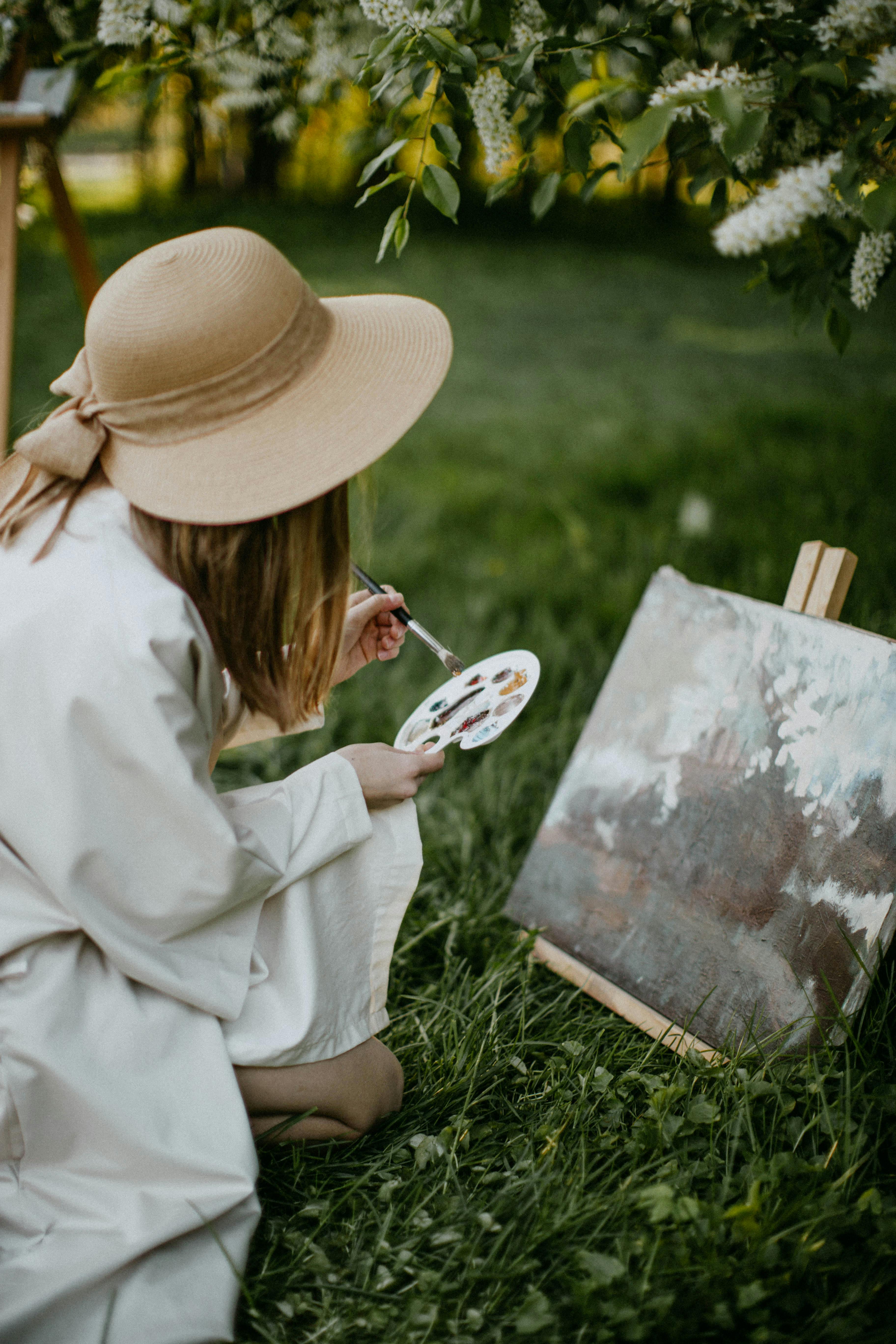
Every seasonal canvas is an original bespoke abstract California landscape. Guests who attend across seasons build a collection. The finished piece is gallery-proportioned and genuinely yours — a 16×20" linen canvas you'll be proud to hang.
Who This Evening Is For
The women who find Linger & Savor most meaningful tend to share a few things. They're in their mid-thirties to early sixties. They've built something significant — a career, a family, a reputation. They're excellent at what they do. And they've quietly lost the thread of who they are outside of it.
They're not looking for therapy. They're not looking for a party. They're looking for an evening that takes them seriously — that meets the sophistication of their life with an experience worthy of it.
They usually come with one friend. They always tell every woman they know afterward.
A Note on the Science Behind the Experience
Every element of a Linger & Savor evening is grounded in neuroaesthetic research. The intimate group size leverages co-regulation theory. The wellness facilitation draws on somatic and breathwork practices with evidence-based nervous system effects. The guided painting activates embodied cognition — research shows the motor cortex engages when viewing even a brushstroke, meaning the body participates in the creative act, not just the hands.
The sensory tasting is structured around slow, deliberate attention — a neurological event, not a preference. The atmosphere — lighting, scent, sound, texture — primes the brain's predictive model before a single brush touches canvas. None of this is incidental. It's designed to evoke peace, presence and calm back into your life.